 Starting from Scratch
Down beats should probably be explained by someone with more experience than myself, however this blog is for my own notes, and so I will treat it as such. Down beats are the easiest (and most visible) way to keep time with a given track for the purpose of beat matching and synchronization.
If you speak out loud “One, two, three, four” to a beat, this will be the essentials of a down beat. The beginnings of each of those words are the start of a down beat. That is typically how software these days matches up beat grids for you to be easily able to start on the down beat or the first part of the beat grid.
There is also something called an up beat, which is generally (as far as I know currently) right before the next down beat. Using the example above, the up beat would be if we added “and”s to the speech above. “One and, two and, three and, four (and)” in repetition creates the down beat with each number, and the up beat with each “and”. From what I can tell, each time the down beat is on its way out from being hit.
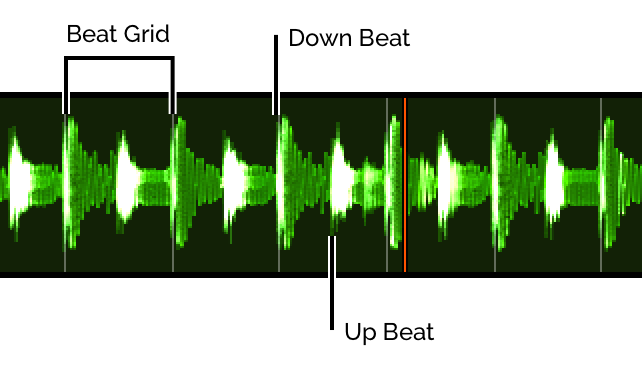
The lines below show a typical beat grid, with each line being the start of the down beat. The up beat is when that beat is fading (the “and”) in preparation for the next down beat. The next one is needed otherwise the music is dead. That’s bad.
